
Last week I asked Google AI Mode a messy, real buyer question: “Which project management tools work for a 12-person agency that already uses Slack and hates onboarding?” Instead of ten blue links, I got a synthesized answer comparing four platforms with citations to about seven domains. I followed up on pricing under 15 seats, and it remembered the whole thread. Neither query sent me to a website.
That’s the shift. The destination used to be a page. Now it’s the answer, and your content is either in it or invisible for that person. For content and SEO teams, ranking still matters, but it’s now an input to citation, not the finish line. The job is to become a source Google’s AI trusts enough to quote.
Key Takeaways
- AI Mode passed 1 billion monthly users in about a year (Google I/O 2026), with queries more than doubling every quarter. AI Overviews reach roughly 2.5 billion.
- AI Mode and AI Overviews cite the same URLs only 13.7% of the time across 540,000 query pairs (Ahrefs), even while agreeing on the answer ~86% of the time. Same infrastructure, different sources.
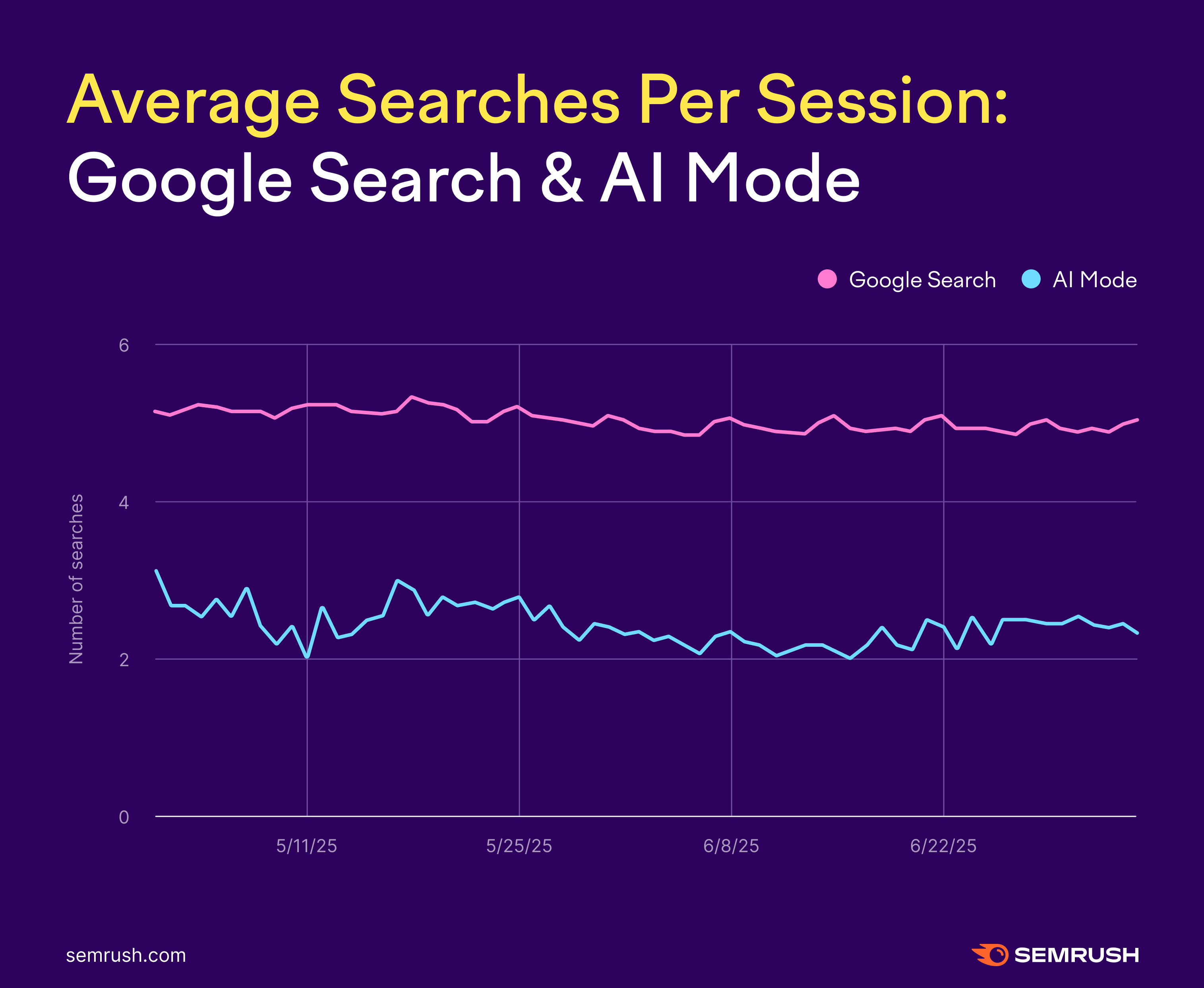
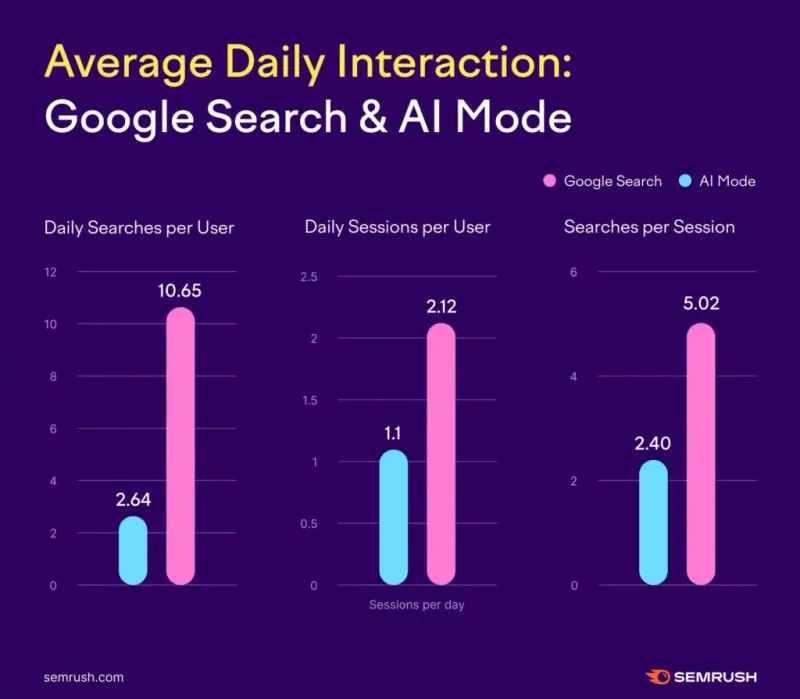
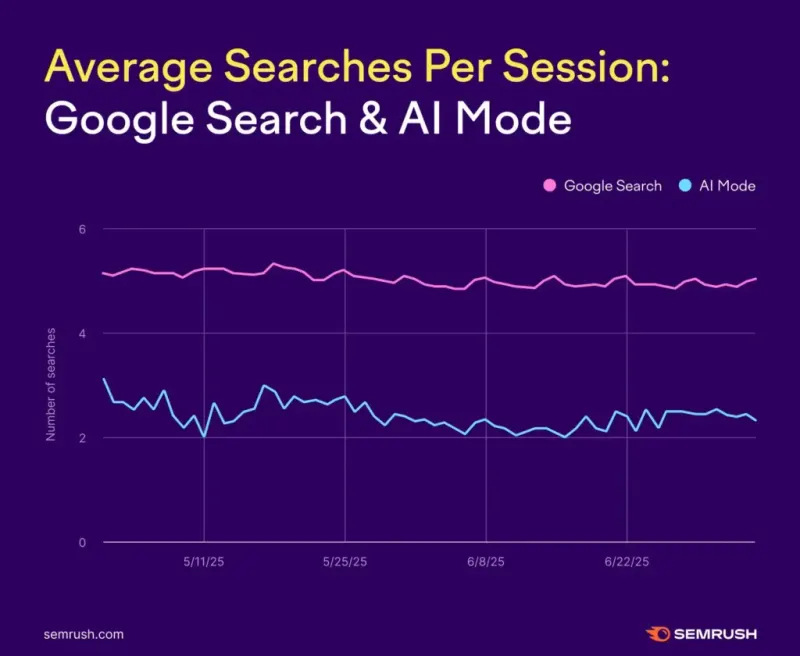
- 92–94% of AI Mode sessions end without a click (Semrush). Across all of Google, 68% of searches are now zero-click (SparkToro, 2026).
- AI Mode queries run about 3x longer than traditional ones, and planning-type queries are growing fastest.
- Google added generative AI performance reporting to Search Console in June 2026, so this is finally measurable.
How Does Google AI Search Actually Work?
Google AI mode runs on Gemini (Gemini 3.5 Flash became the default in mid-2026), and leans on a technique called query fan-out. Instead of lining your words up with a single results page, it breaks your question into a bunch of smaller subqueries, runs them in parallel, pulls from different sources, and then stitches the results into one response. If you ask about “family-friendly hotels near Yellowstone with pools,” behind the scenes it may run separate searches for lodging, amenities, distance, and reviews, then merge it all together.
If you’re a geek, this is impressive.
But even if you’re a normie, this matters more than it sounds. A page that just answers your primary keyword gets retrieved for one facet of one sub- query. But a page that covers the nearby questions as well can end up being pulled into the same response multiple times, across several sub-queries, all within one session. So retrieval turns multiplicative instead of landing in a single ranking slot.
It’s also basically why a typical AI Mode response cites about seven domains, and why 97% of those have at least one citation. Gemini is putting together an answer from many pages, not really crowning one single winner.
Google AI Mode vs. AI Overviews: What’s the Difference?
They share Gemini infrastructure but perform different jobs, and the visibility opportunity differs for each.
| AI Overviews | AI Mode | |
| Format | Summary above the normal results page | A separate conversational search experience |
| Best for | Quick, single-answer queries | Multi-step research and comparison |
| The blue links | Still visible below the summary | Focus shifts almost entirely to the answer |
| Interaction | Mostly one-and-done | Remembers context, supports follow-ups |
| Your goal | Get cited and keep the click available | Get cited, because the click may never come |
The issue is treating them as one channel. Like, if they overlap on cited URLs only about 14% of the time, then a page that wins citations in AI Overviews can still be missing entirely from AI Mode on the exact same topic. So, you have to watch both paths and optimize each one, not just assume “close enough”.
Why This Is a GEO and AEO Problem, Not Just SEO
For years, SEO was basically about getting into a list. GEO (Generative Engine Optimization) and AEO (Answer Engine Optimization) raise the bar, though, because now the target is much more specific: securing placement within the generated response itself, not merely appearing nearby.
And no, the basics did not vanish. Google still wants trustworthy, authoritative sources, and ranking still works like an upstream gate (the top 3 pages are way more likely to get cited than pages sitting around 31 to 100).
So GEO isn’t trying to replace SEO. It’s stacked on top of it.
If your page is basically interchangeable with the other nine results, the AI has no real reason to quote you word for word, rather than grabbing the same idea from a competitor.
So the real trouble is commodity content, not AI “bias”.
That’s why the question shifts from “how do I rank?” to “why would Gemini pull my sentence instead of an identical one from someone else’s page?” Honestly, it usually wouldn’t happen unless you supplied something those other pages don’t.
The Data You Should Use to Adjust Your 2026 Content Plan
Most “AI search” posts sort of ignore this part without real numbers. Here it is anyway, with sources.
Zero-click is basically the default now, not a rare exception. Semrush clickstream work suggests AI Mode zero-click sessions work at about 92–94%, while traditional Google Search is more like 34–43%. So if your whole content model assumes someone has to click, then the model is off, for this surface.
Citation still matters, but in a specific way. Studies show that Google AI overviews reduce organic clicks by 38%.
Can Google Spot AI-Generated Content, And Does It Matter?
In short, Google isn’t doing a simple “was-this-written-by-AI” penalty, and honestly that’s not even the right thing to optimize around. Google’s own guidance points toward people-first content/helpful content. AI-assisted or not, interchangeable pages tend to lose. The pages that win are specific, sourced, experience-backed, the kind you can’t replace with a template.
The failure mode I see most is teams writing in this kind of stiff, “AI-friendly” voice to surpass their competitors.
It backfires, pretty fast.
What ends up getting cited reads as if it came from someone who has actually done the thing, because that’s the exact signal Gemini is trying to surface, not the “optimized phrasing” part.
So don’t write for the machine. Write what the machine can’t fake, and then lay it out so it’s easy to lift.
How I’d Tune For Google AI Mode
Become a source, not some landing page
Cover the topic thoroughly enough that quoting you is the path of least resistance. That means real numbers instead of “affordable,” named entities instead of “various tools,” and an actual point of view instead of an updated summary of the first page of Google.
Design for the follow-up – beyond just the first query
If someone is looking at a CRM, they’ll then ask about pricing, integrations, migration pain points, and alternatives right after. If you handle all of that on the page (or within a tight cluster), you can retrieve it across the whole conversation, not just once.
Publish original research and first-party insights
AI is good at summarizing what already exists, but it can’t recreate your survey, case study, customer data, or your own test results. That’s the one thing that’s structurally defensible, and honestly it’s the only thing that really holds up.
Strengthen brand and entity signals
Gemini tends to trust brands that are consistently mentioned in the places it already trusts on, like industry press, Reddit, LinkedIn, and credible directories. Not just pages where people drop backlinks pointing to you. Consistent authorship, expert bylines, real reviews, and outside mentions help Google understand who is behind the content. If an AI doesn’t really “know” your brand exists, then a citation is way less likely, even if the page itself is solid.
Don’t neglect your Google Business Profile
When the Google AI mode rolls out agentic calling and booking, Google can only recommend and transact with businesses whose details it can confidently read. Accurate categories, hours, services, and reviews are now basically inputs to whether the AI surfaces you at all for local intent.
How Do You Measure AI Mode Performance?
Until recently, we were all guessing how we were doing on AI search visibility. In June 2026, Google added generative AI performance reporting to Search Console, showing how often our content appears across AI mode and AI overviews. It’s still maturing, but it’s the first native way to see AI visibility separately from classic rankings, so we stop mixing signals and know what happened.
Keep an eye on one pattern that usually means trouble: impressions climbing while clicks drop. It often signals that Google is showing your stuff in an answer format, but not actually giving the user a reason to tap through. When you see that, the “defense” isn’t more prose, or better wording. The defense is giving the page something an answer box can’t really mirror, like a calculator, a side-by-side comparison, proprietary data, that kind of thing, so the visitor still has a reason to come to you.
Where Google AI Mode Is a Bad Match (And the Vendors Don’t Really Tell You)
Google AI mode won’t rescue poorly structured and less informative content. And it comes with real drawbacks, ones that are worth naming, not hand-waving away.
It’s a risky move if your whole traffic plan relies on huge volumes of those informational clicks that AI now answers directly. Those taps are fading, and no amount of tweaking brings them back at the same size. So if that’s basically your entire pipeline, you probably need to shift toward pages that lead to a decision, a signup, or at least some measurable action, rather than aiming for pageviews only.
Also, it’s not a dependable single source of reliability. AI Mode synthesizes, and it can be confidently incorrect, like, without warning. Plus, personalization means two people can get two different answers for what looks like the same search. So you can’t fully “audit your ranking” the same way anymore. And chasing citations on low-intent informational queries can be a slow drain, because a cited response that never turns into a conversion is kind of a vanity measurement, right?
Takeaways for Marketers and Content Teams
You need to optimize for both Google AI mode and AI Overviews. They end up using different URLs, so don’t assume it’s the same playbook. Also, keep those strong organic rankings, because rank is kind of the upstream gate that citations pass through.
Write in a way that fits conversational, multi-part queries, then the follow-ups that show up right after. Invest in original research and firsthand experience too, since AI can’t fully replicate that kind of signal. Beyond backlinks, build brand and entity signals across the web, not just one link graph. And keep an eye on the new Search Console AI report, specifically the impressions-up, clicks-down pattern; that’s a big tell.
What’s coming next is fewer clicks, but the clicks are higher intent. So you’ll want to rebuild the funnel around that reality. The brands that end up winning won’t be the ones with the most keyword-stuffed pages. Instead, they’re the ones who keep publishing stuff people actually find useful, trustworthy, original, and clear enough that Gemini feels comfortable attaching its name to it.
The Bottomline
Google AI Mode search engine isn’t killing SEO as much as it is changing what organic discovery looks like. It’s less about fighting for a spot on a results page now, and more about competing for a place inside the answer itself. In practice, that means content that’s genuinely helpful, supported by real expertise, and distinct enough that AI systems can trust it and cite it.
The good news: the fundamentals haven’t disappeared. High-quality content, topical authority, solid technical SEO, and a credible brand are still the base. The change is that you now have a new priority on top of that: publishing original insights, firsthand experience, and well-structured information that answer engines can reference without hesitation.
As AI-powered search becomes the default, brands that jump in early will likely gain a real edge over others. Instead of constantly chasing keywords and optimizing for clicks, you’d want to try to be the most trustworthy source on your subject.
FAQs
Open Google Search and tap the AI Mode tab next to “All,” or start typing a longer, multi-part question directly into the redesigned search box. No sign-up is required anymore; it rolled out of Search Labs into the main product in 2025.
No. Short, simple queries mostly still get standard results or an AI Overview. AI Mode’s conversational answers show up for longer, comparison-style, or research-type questions, and once you’re in an AI Mode thread, follow-ups stay in that mode.
Normal SEO is still the floor. Rank is a filter Google applies before it decides what to cite, so a page that can’t rank won’t get pulled into an AI Mode answer either. GEO adds a second bar on top: even a well-ranked page needs original, specific information a generic competitor doesn’t have to actually get quoted.
Measurement. Most teams still can’t see where their content shows up inside AI Mode answers, only whether it ranks. The Search Console generative AI report (added in June 2026) is the first fix, but it’s new and incomplete, so a lot of visibility is still missing.