
Old-school marketing was about long hours analyzing spreadsheets, trial-and-error campaigns, and hoping for the best. But today, AI marketing tools are changing the rules of the game. I’ve seen marketers who once spent long hours in manual data analysis now get real-time insights in seconds – thanks to generative AI (genAI) tools that simplify decision-making.
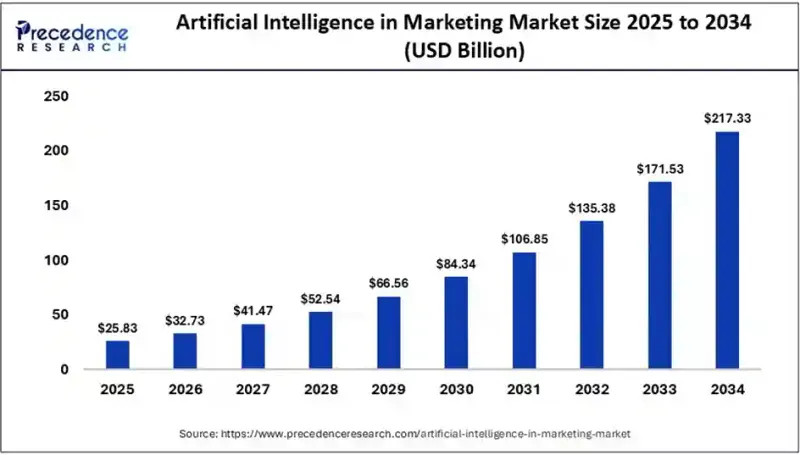
The market speaks for itself – the global artificial intelligence in the marketing sector will likely reach $25.83 billion in 2025 and grow to over $217 billion by 2034, at a remarkable CAGR of 26.7%. The fastest growth is happening across the Asia Pacific region, where businesses are integrating AI into their marketing strategies faster than ever.
But here’s the catch – with hundreds of AI tools for marketing, choosing the right ones can be confusing. The goal isn’t to use AI for the sake of it; it’s to make marketing smarter, faster, and more personalized for the target audience.
In this guide, I’ll share the list of best AI marketing tools that’ll help you plan, create, optimize, and analyze campaigns efficiently, without losing the creative spark that makes your brand human.
Key Takeaways
- AI marketing tools have moved from simple automation to smarter content creation, analysis, and hyper-personalization.
- The top AI tools for marketing – ChatGPT, Canva, DeepL, QuillBot, and Gemini – simplify daily workflow by saving time and improving creativity.
- I’ve found these AI marketing tools helpful for content writing, design, translations, presentations, and brainstorming – each fits differently depending on your workflow.
- Using AI in marketing strategy is about balance – let these tools handle the repetitive parts so you can focus on ideas, storytelling, and decision-making.
How AI Marketing Tools Are Transforming The Sector?
Marketing has come a long way from manually searching through data and crafting content piece by piece. Today, AI tools are revolutionizing how we operate, making processes faster, more accurate, and highly personalized.
Here’s what genAI tools can do better:
- Automate repetitive tasks: AI handles time-consuming tasks like data analysis, content generation, and customer segmentation. This automation frees up your time to focus on strategy and creativity.
- Predicting customer behavior: By analyzing past interactions, AI can predict customer actions and tailor your marketing efforts more effectively.
- Hyper-personalizing campaigns: AI tools for marketing allows for the creation of hyper-personalized content at scale, including SEO-optimized articles and AI-generated videos.
For instance, we at yMedia assist you with engaging AI video content, editing, and marketing that resonates with your brand’s audience.
Impact of using AI in marketing strategies:
- Faster content creation: You can generate AI content swiftly, reducing turnaround time.
- Improved targeting: AI analyzes customer data to identify the most promising segments, their behavior, and suggests custom responses.
- Real-time analytics: Instant insights help in making data-driven decisions promptly.
According to a Gartner report, by 2026, over 80% of enterprises will have tested or deployed GenAI-enabled applications, highlighting the growing reliance on AI in marketing strategies.
Why and How Did I Choose These AI Marketing Tools?
When looking at AI in marketing, I wanted to focus on tools that most of us have interacted with at some point – whether for work, personal planning, or simple curiosity. I considered factors like usability, practical features, and how well these AI marketing tools integrate into workflows.
Monthly traffic stats also helped highlight which tools are widely trusted globally. The list gives a clear snapshot of top AI tools for marketing.
Comparing the Top AI Tools For Marketing
| Sr.no | Top AI tools for marketing | Best for | Monthly traffic | Price and plans |
| 1 | ChatGPT | Ideation, content creation, writing product descriptions, ads, image generation, smart presentations, writing, code, and more. | 321,600,000 | – Free version– Go: $4.5/month- Plus: ~$23/month- Pro: ~$225/month – Business: ~$24/month- Enterprise: Custom plan |
| 2 | Canva | Social media graphics, short-form videos, visual branding, and marketing presentations | 285,700,000 | – Free version– Pro: $45/year for a person- Teams: $45/year/person- Enterprise: Custom plans |
| 3 | DeepL | Localizing campaigns, translating marketing content, emails, and ad copies to maintain consistent brand messaging across languages | 167,000,000 | – Free version– Individual: $8.74per month for a single user– Team: $28.74per user/month- Business: $57.49per user/month– Enterprise: Custom plans |
| 4 | QuillBot | Rewriting or paraphrasing content, summarizing articles, improving tonality, and grammar | 100,900,000 | – Free version– Premium: $4.17/month- Team: Custom plans depending on the number of writers using. |
| 5 | Gemini | Marketers who need fast, AI-driven insights, campaign brainstorming, Google Workspace projects, quick summaries, briefs, and ad copies. | 60,800,000 | – Free version– Google AI Pro: $0 for the first month- Google AI Ultra: $124.99/month for 3 months |
Best AI Marketing Tools You Should Explore in 2026
Let’s briefly discuss each of these the top AI tools by monthly traffic and how they can transform your marketing game and brand messaging:
1. ChatGPT
I’ve found ChatGPT to be one of the most versatile AI tools for marketing. From brainstorming campaign ideas to generating blog drafts, it can save hours of work while keeping your messaging consistent. You can even create custom versions of GPTs and try various instruction combinations.

For many, it’s become the go-to AI marketing tool for blending creativity with efficiency. It’s ideal if you’re someone who wants to create, refine, and automate marketing content, while keeping room for your own creative input.
Key features:
- Generates human-like text across multiple languages and formats.
- Can analyze, summarize, and rewrite long documents in seconds.
- Integrates easily with marketing apps and workflows through API.
- Adapts tone and structure based on prompts and audience context.
Pros:
- Cuts down research and content creation time significantly.
- Easy to use, even without a technical background.
- Flexible enough to support multiple use cases – from blogs and programming to lifestyle and recipe insights.
Cons:
- Sometimes produces generic or repetitive output without strong context.
- Needs clear prompts for accuracy and tone consistency.
- May generate or produce outdated or inaccurate stats.
Pricing plans:
- Free plan available with limited access to features.
- Other plans include Go, Plus, and Pro.
- ChatGPT Plus, at ₹1,999 INR/month, is a popular expanded plan that offers advanced intelligence features and the GPT-5 model with reasoning.
2. Canva
I’ve used Canva for almost everything – from designing posters and short videos to creating presentation decks and social media posts. It’s one of those top AI tools for marketing that genuinely simplifies design work, especially for those who don’t have access to a full creative team.
What makes it stand out is how easy it feels to create professional visuals in minutes without needing advanced design skills.
Key features:
- Built-in AI tools like Magic Write for captions and Magic Design for instant templates.
- AI video editor that creates short clips from text or existing footage.
- Smart resizing for multi-platform use (Instagram, YouTube, LinkedIn, etc.)
- Huge library of templates, elements, and brand kits.
Pros:
- Saves time with automated design suggestions and quick resizing options.
- Easy to cooperate with team members on shared projects.
- Integrates well with marketing tactics – perfect for social media trends and planning.
Cons:
- Some advanced templates and stock assets are restricted to the paid plan.
- AI text and video generation features still need refinement for unique outputs.
Pricing plans:
- Free plan with standard templates and limited storage.
- Canva Pro and Teams: ₹4,000 INR annually with premium assets, AI features, Cloud storage, and more.
3. DeepL
I haven’t used DeepL much, but I tried it out of curiosity to see how it stacks up against Google Translate. What stood out instantly was how natural the translations sounded, especially for marketing copy or social media captions.
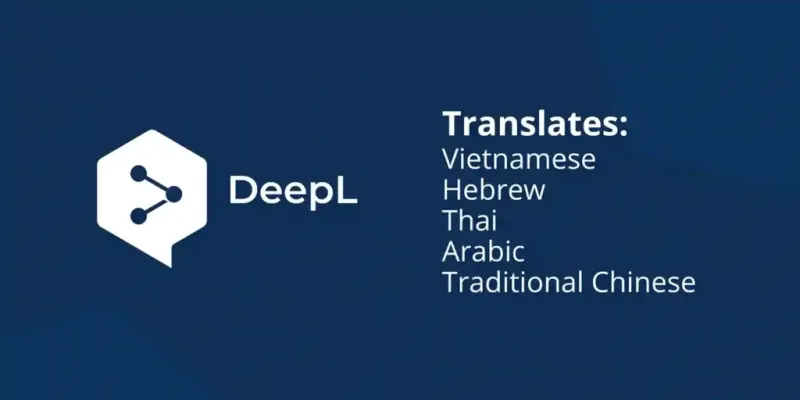
If you deal with multilingual campaigns or global clients, this is one of those generative AI tools that helps you communicate clearly without losing tone or brand intent.
Key features:
- High-accuracy AI translation for 35 languages.
- Built-in tone adjustment for formal or casual communication in marketing.
- DeepL Write helps in grammar correction and writing improvement.
- Integrations with apps like Microsoft Word and Chrome are possible.
Pros:
- Delivers human-like translations that keep context intact.
- Easy to use with a clean interface for various social media campaigns and posts.
- Great for marketers managing multilingual projects globally and targeting a local audience.
Cons:
- Limited language support compared to Google Translate.
- Free plan restricts document uploads and limits access to advanced features.
Pricing plans:
- Free plan available for basic text translations.
- DeepL upgrade starts at $8.74/month for improved data security and full page translations.
- Upgrade to Team, Business, or Enterprise plans to unlock the full advanced features.
4. QuillBot
I tried QuillBot to edit a few social captions, and I was surprised by how naturally it reworded sentences without making them sound mechanical. It’s a great AI tool if you’re handling content-heavy marketing tasks – whether it’s rewriting ad copy, summarizing reports, or polishing blog drafts.
For anyone exploring AI in marketing strategy, QuillBot makes editing feel effortless and consistent.
Key features:
- Paraphraser with multiple modes (Standard, Creative, Formal) adapts content phrasing without losing context.
- Grammar and spelling checker highlights errors and suggests corrections within the content.
- The summarizer tool condenses text into a shorter version or bullet points.
- Plagiarism detector (available in premium) and citation generator verify originality of the content.
Pros:
- Easy to use – even for non-writers – thanks to its clean interface and clear suggestions.
- You can adjust the strength, tonality, or style of rewriting via AI Humanizer and translation.
- The free plan gives a solid taste of its capabilities, letting you try paraphrasing, summarizing, and grammar checks with limits.
Cons:
- The free version restricts certain modes and caps paraphrasing at 125 words per use.
- For complex statements, some paraphrased output may feel a bit generic or awkward, especially for complex sentences.
- Premium plans unlock advanced features and AI capabilities.
Pricing plans:
- Free plan with basic paraphrasing (125 words) and summarizing up to 1,200 words with limited modes of tonality.
- Premium plans are available for more advanced features.
5. Gemini
I’ve tried both ChatGPT and Gemini since their early versions, and honestly, they’ve been competing head-to-head from the start. Gemini 2.5 feels smooth, quick, and more visually aware than earlier models. It’s reliable for marketers who want deep research, smart ideation, or structured campaign content.
I usually switch between both tools – ChatGPT for conversational tone and Gemini for deep research, image edits, or other creative briefs.
Key features:
- Successful integration with Google Workspace tools like Docs, Sheets, and Gmail.
- Image and video generation with Gemini 2.5 for better context in responses.
- Context-aware chat for campaign analysis and report writing.
- Strong fact-checking accuracy for research-heavy content.
Pros:
- Gemini integrates well within Google’s ecosystem – no extra setup required.
- It generates structured, data-backed strategies for marketing.
- Great for teams who want research and execution under one platform.
Cons:
- May feel too formal for brands needing a more conversational tone – need to rewrite prompts and train.
- Limited personalization compared to ChatGPT’s longer memory capabilities.
Pricing plans:
- Free plan with limited usage and basic features.
- Gemini Advanced (part of Google One AI Premium) with extended tools and higher model access.
How to Choose the Right AI Tool For Marketing Stack
Picking the right AI tools can feel confusing at first – there are new ones released in the market frequently. Here’s how you can decide on one:
- Identify your main pain point: Start by pinpointing what’s slowing you down – is it content creation, translation, data analysis, ad optimization, or lead conversions? AI marketing tools should be able to solve one clear problem at one time.
- Start small and expand: Pick one category and test it for a few weeks. Once you see results, explore more with AI in marketing strategies to gradually build and expand your stack.
- Check integrations: Top AI tools like Gemini and QuillBot fit well in Google Workspace, Grammarly works through browser extensions, and ChatGPT connects easily with multiple apps. Integration saves time in switching between tools.
- Test usability: Use free trials to see how each of the top AI marketing tools aligns with your workflow before paying for a subscription.
The Bottomline
So, what I’ve realized is that there’s no single perfect AI marketing tool for your needs. The best tool is the one that fits your marketing goals and feels natural to use. Some days I rely on ChatGPT for content ideas, other days Canva or Gemini make more sense depending on the task.
My advice? Experiment. Try different AI tools for marketing, mix them into your workflow, and see what sticks and helps your business grow. The more you test, the better you’ll understand how to use AI in marketing effectively – not just for productivity, but for smarter creative decisions.
To know more about how we integrate these tools in our yMedia workflow, reach out to us and get assistance with AI content, social media marketing, AI video editing, and more.
Frequently Asked Questions (FAQs)
1. What is generative AI, and how does it work?
Generative AI is an intelligent model that creates new content – text, images, or videos – based on learned data patterns and human prompts. GenAI tools use large language models and predictive algorithms to produce outputs.
2. Which AI marketing tools can I use for SEO content writing?
Some popular AI marketing tools for SEO content writing include ChatGPT, Journalist AI, Claude AI, and QuillBot. Each supports keyword optimization, content structure, and readability.
3. What are the risks of generative AI tools?
AI in marketing can sometimes produce inaccurate data, biased content, or mimic existing work too closely. There’s also the risk of over-reliance, where you may skip fact-checking or originality.