
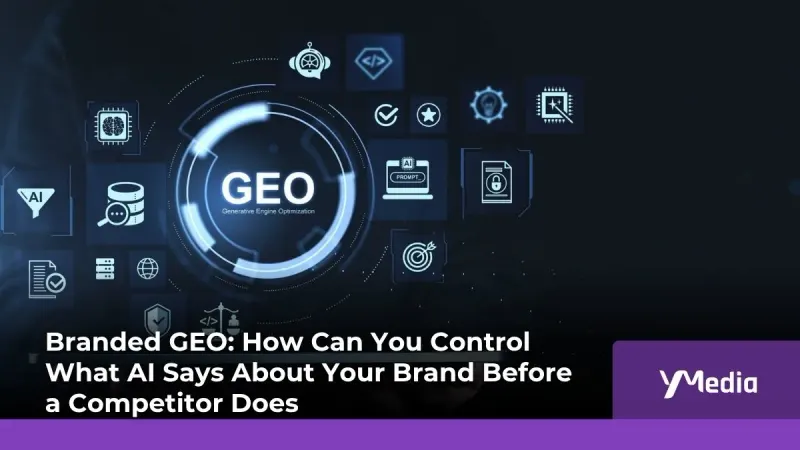
You can’t directly control what an AI says about your brand. But you can change what it reads, and in effect, influence what it says. Most “control your AI narrative” advice skips past this difference, which is why it rarely survives contact with an actual model. Branded GEO (branded generative engine optimization) means auditing how AI answer engines describe your company on branded prompts, tracing each wrong or missing detail back to the source the model pulled it from, and fixing that source so the next answer comes out better. This is also called AEO – Answer Engine Optimization – where you’re influencing the answers that LLMs or Google Search Overview provide.
This matters because customers now ask ChatGPT, Gemini, and Perplexity about a company before they ever reach its website, and whatever the AI tells them colors every touchpoint after.
Key Takeaways
- You influence the AI; you don’t control it. Fix what it reads (your site, Wikipedia, LinkedIn, reviews), and the answer eventually catches up.
- Run a baseline this week. Ask 5 question types across 2–3 AI engines, score each 0–4, and you’ve got a number to track instead of a guess.
- Not all wrong answers have the same cause. Stale page, contradicting profiles, missing answer, or outright hallucination, each needs a different fix.
- Speed depends on how the AI answers. Engines that read the live web can catch up in days to weeks. Ones answering from frozen memory won’t budge until the model itself is updated.
- Skip it if the timing’s wrong. Barely anyone’s asking AI about you yet, or you’re mid-pivot, or the AI’s “wrong” answer happens to be true? Fix that first, not your AI visibility.
Why AI Answers Now Shape Brand Perception More Than Your Homepage
ChatGPT has more than 900 million active users. Answer engines have wedged themselves between your buyer and your website right when intent peaks, on the branded, bottom-of-funnel question. A prospect types “is [your product] good for enterprise” into ChatGPT, and the model, instead of sending them to your homepage to decide, decides for them and hands back a verdict in three sentences.
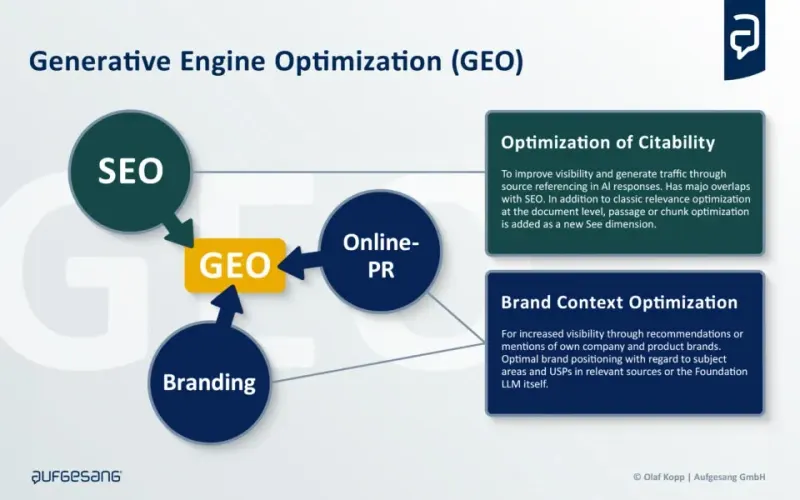
How it decides is based on entity consensus and not search ranking. An AI model builds its picture of your brand by reading how your business/product is described across many sources at once: your site, Wikipedia, LinkedIn, review platforms, directories, press, forum threads.
When those sources agree, it answers confidently.
When they contradict each other, it hedges, defaults to the most-repeated version (usually the outdated one), or provides an answer with a plausible guess. That’s how a single old blog post can outweigh all the SEO you redid last week.
If your competitor publishes clearer, more consistent content about themselves, they can get their framing absorbed by a model before you notice, and while I don’t have data to make this claim, I think correcting a model after the fact costs far more than getting there first.
How ChatGPT, Gemini, Perplexity, and AI Overviews Each Build an Answer About a Company
The same branded prompt by a user gets handled by four different retrieval systems, so a change that corrects ChatGPT can leave Google AI Overviews completely untouched.
| Engine | Primary source of brand info | What moves the answer fastest | Blind spot to exploit |
| ChatGPT (search off) | Pre-training prompts | Nothing short-term; only future model updates | Answers can be months or years stale on positioning |
| ChatGPT (search on) | Live web fetch at query time | Updating the high-ranking pages it fetches | Depends heavily on a handful of top results |
| Google AI Overviews / Gemini | Google Search index + Knowledge Graph | Ranking pages plus a correct Knowledge Panel entity | Ignores content Google hasn’t indexed or trusted yet |
| Perplexity | Real-time retrieval, citation-first | Being the clearest citable source for the exact query | Rewards structured, quotable pages over marketing prose |
| Claude (search on) | Live web fetch, cautious sourcing | Corroboration across two or more credible sources | Discounts single-source or promotional claims |
Two rules come out of this:
- First, find out which engine your buyers actually use before you start fixing your content/information: enterprise B2B skews toward ChatGPT and Perplexity, while local and consumer queries lean on Google AI Overviews.
- Second, some LLMs go and read the internet right when you ask something, while others just answer from memory. The ones that read live (Perplexity and ChatGPT with search on) will see your fixes soon after you make them. The ones answering from memory keep repeating the old version until the AI gets retrained, no matter what you change.
Run a Brand Answer Audit: A 25-Prompt Scoring Method
Everyone tells you to ask ChatGPT what it says about you. Nobody tells you how to turn that into a number you can track quarter over quarter or hold up against a competitor.
Go about that using what I call the grid. Pick five branded prompt types and run each across the five engines your buyers use. Run every cell in a fresh or temporary session with personalization off, so your own history doesn’t skew the result (way more common than you’d think, btw).
The five prompt types:
- Identity: “What is [brand] and what does it do?”
- Fit: “Is [brand] good for [your core use case]?”
- Comparison: “[brand] vs [top competitor].”
- Objection: “What are the downsides or limitations of [brand]?”
- Recommendation: “What’s the best [your category] for [buyer type]?” (Does your brand come up unprompted?)
The score: Rate each of the 25 cells 0 to 4 on one dimension, accuracy and completeness, then average them.
| Score | Meaning |
| 4 | Accurate, current positioning, names a real differentiator |
| 3 | Accurate but generic or slightly dated |
| 2 | Partly wrong or missing a core fact |
| 1 | Materially wrong (wrong features, wrong category, wrong price band) |
| 0 | Absent, or recommends a competitor instead |
A Brand Answer Score under 2.5 out of 4 means forget underperformance – AI search is actually costing you deals. Look at every 0 and 1 with the exact prompt, the engine, the date, and the specific wrong claim. That’s what deserves your attention.
The Four Reasons AI Describes A Brand Wrong
| Failure mode | What it looks like | Root cause | Correct fix |
| Old source | Old positioning, features not updated, old pricing | A cached page or article the model still values | Update or remove that specific source |
| Entity inconsistency | Model can be confused or blends two versions of you | Your LinkedIn, homepage, and Crunchbase provide varied information | Align every profile to one canonical description |
| Missing answer | Vague reply or “I don’t have information on that” | No source answers the question at all | Publish the definitive answer yourself |
| Hallucination | Confident, specific, and false | Model guessed to fill a gap | Publish a clear source, then wait for re-crawl |
Search for the exact wrong phrase the AI used. If you find a stale-source or inconsistency problem, it can be fixed manually. Or maybe the model invented it, so your only move is to publish authoritative content that gives it something true to grab instead.
Fixing Each Failure Mode at the Source
Fix Your Own Website (fastest):
- Rewrite your homepage, product pages, docs, and help center to state your current positioning in plain, informative language.
- Write your full brand name and category instead of relying solely on a clever tagline, because models match on entities, not vibes.
- Add or correct Organization and Product schema so the structured data repeats the same facts.
- An llms.txt file can point AI crawlers at your canonical brand descriptions.
Third-party fixes (slower, but more impact): The content on Wikipedia can make or break your AI search engine’s answers, so a correct, well-sourced entry there beats ten homepage edits. Update your LinkedIn, Crunchbase, G2, and directory listings with a similar canonical description. For outdated articles on sites you don’t own, the honest route is to reach out to update or annotate them; where that fails, publish enough new, accurate sources to shift the focus yourself.
How fast do things move?
| Source you change | Typical time to appear in AI answers |
| Your own indexed pages | Days, once re-crawled by the engine |
| Wikipedia and high-trust entity sources | Weeks after the edit stabilizes |
| Broad third-party corpus (many sites) | 1 to 6 months of compounding |
| Model pre-training (search off) | Only at the next model release |
When Branded GEO Is the Wrong Priority
No competitor’s guide will tell you this, since it might talk you out of a project. Branded GEO is a poor use of your budget when:
- Almost nobody searches your brand in AI yet: If branded prompt volume is negligible and buyers still find you through referrals or paid, fix demand generation first. Branded GEO improves the last mile; it doesn’t create the traffic.
- Your product is genuinely mid-pivot: If your positioning changes again in three months, wait. Otherwise, you re-teach the search engine twice and confuse the model in between.
- The wrong answer happens to be true: If the AI says you lack a feature and you do, that’s a product gap. You’ve got to change the claim.
- You’re chasing a frozen model: If your audit shows the bad answers come from ChatGPT with search off, no amount of publishing moves them before the next model version. Spend the effort where retrieval is live.
- You expect literal control: If the goal is to sign off on every sentence an AI writes about you, branded GEO can’t deliver it, and no honest vendor will claim otherwise. You’re buying influence over probability, not an approval workflow.
The Bottom Line
Branded GEO isn’t a thing you win once. It’s closer to hygiene. Always required, never finished. All the fixes in this post largely come down to cleaning up a source and waiting for the model to catch up.
The most important takeaway here would be to take the test with five prompts, two engines, personalization off – should take an hour of your time. You’ll come away with a number and a short list of the exact sentences costing you deals, and that list beats any strategy deck. Fix the 0s and 1s first, re-run the grid next month, and let the score tell you whether it’s working.
FAQs
Yes. General GEO aims to surface your content in AI answers for broad, non-branded category queries. Branded GEO is narrower and higher-intent: it targets prompts that already contain your brand name and prioritizes accuracy over mere presence. It sits closer to reputation and entity management than to content marketing.
No, and any tool promising literal control is overselling. You influence the sources these models retrieve and train on. The model still writes its own wording. Realistic branded GEO improves accuracy and consistency and lowers the odds of a damaging answer; it doesn’t hand you an approval button.
Depends on the source. Edits to your own indexed pages can show up within days of a re-crawl. High-trust sources like Wikipedia take weeks to settle. The broader web of third-party mentions compounds over 1-6 months. Anything coming from a model’s frozen training data won’t change until that model is updated.
Smaller brands often have more to gain and more to lose. Large ones usually have sufficient authoritative coverage for search engines to describe them reasonably well. A smaller company with thin external coverage is both easier to shape and easier to misrepresent, so a modest, steady effort can genuinely change its AI answers.
Run a 10-prompt spot check today across the two engines your buyers use most, using the Identity, Fit, and Comparison prompts, with personalization off. Log every wrong or missing claim next to the source you suspect it came from. That baseline is the whole foundation, and it takes under an hour.