
A travel blog called The Planet D lost 90% of its traffic once AI Overviews was launched, and then shut down for good. That isn’t some outlier scare story. It’s the sharp end of a pattern I’ve been tracking across publishers all year, and it’s changing what ranking well even means for a news site.
One of the most common questions I get is about whether we panic about AI Overviews? But honestly, the answer’s more specific than that. Google Search now answers a large share of queries before a reader ever sees a blue link, and news publishers depend on that click more than almost any other content category.
So, here’s what the data shows about organic traffic losses, where the exceptions are, and what publishers are doing to hold ground in AI search results.
Key Takeaways
- Organic search clicks across a 64-site publisher portfolio fell 42% after AI Overviews expanded.
- When an AI Overview appears, click-through rate on traditional results drops to about 8%, versus 15% without one.
- News and politics content saw only a 7% drop in ad opportunities, far below the 40 to 50% drop in health and careers content.
- Google now embeds Top Stories carousels directly inside AI Overviews on 15.5% of trending U.S. news queries.
- Blocking Google-Extended doesn’t remove a publisher from AI Overviews or from Top Stories placement inside them.
- Zero-click searches rose from 56% to 69% of all Google searches between May 2024 and May 2025.
What Are Google AI Overviews and How Do They Work?
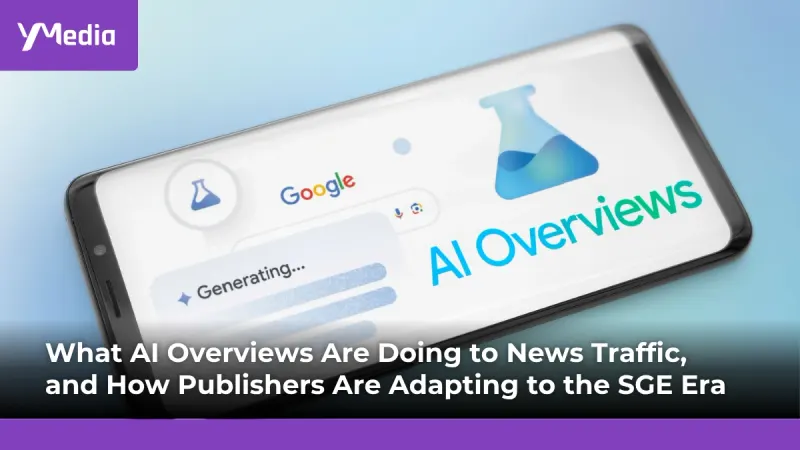
AI Overviews are the AI-generated summary Google Search places above the traditional results list, built by retrieving candidate pages the normal way. And then feeding relevant passages into a generative model that writes one synthesized answer with a handful of linked sources underneath. Google rolled the feature out to all U.S. users in May 2024, and coverage has kept expanding since.
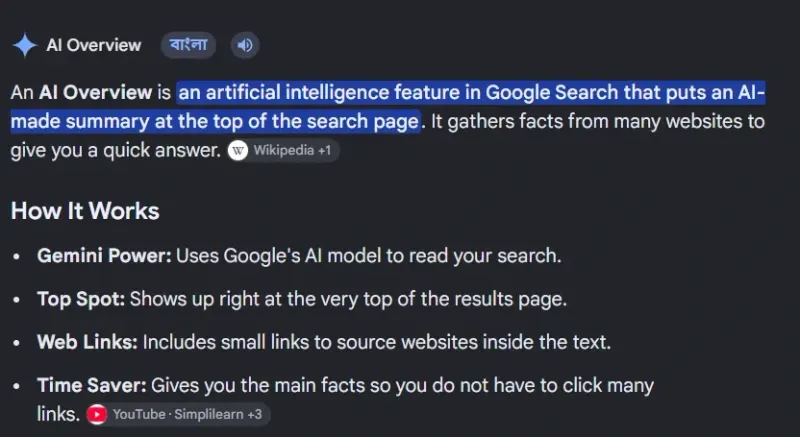
The scale of it is easy to underestimate. Advanced Web Ranking’s study of 8,000 keywords found the average AI Overview runs about 169 words and links to roughly 7 sources. Once one expands, the first traditional organic result often sits around 1,674 pixels down the page, close to two full screens of scrolling before a reader even sees it.
How AI overviews differ from traditional Google search results
The practical differences show up fastest in a side-by-side view.
| Factor | Traditional results | AI Overview |
| What loads first | Ten linked results | One synthesized answer, 5 to 7 citations |
| Reader behavior | Scans titles, picks a source, clicks | Often reads the summary and leaves |
| Attribution | Full headline and snippet per link | Small citation links, easy to miss |
| Publisher control | Title tag and meta description | No control over how the summary is worded |
That last row is very important. You can write the best meta description in the industry, and Google’s model will still paraphrase your reporting in its own words above it.
How AI Overviews Are Impacting News Publisher Traffic
Adsroid’s analysis of 64 sites is the clearest data point. The organic search clicks fell 42% after AI Overviews expanded, with an immediate 16% drop right after the initial rollout. And it further declined as the feature expanded.
But that number hides a split. AI Overviews appear on roughly 15% of news queries, compared to almost 3X that rate for health and science queries. Because Google routes most news searches into the separate Top Stories carousel instead of generating a summary.
In other words, informational and evergreen content is absorbing most of the damage. Breaking news isn’t immune, but it’s not the primary target either.
The decline in CTRs and organic traffic
Pew Research Center tracked 68,879 Google searches made by 900 U.S. adults through a browser extension in March 2025. When an AI Overview appeared, users clicked a traditional result about 8% of the time. Without one, that rate nearly doubled to 15%. Separately, DMG Media, owner of MailOnline and Metro, told the UK’s Competition and Markets Authority that AI Overviews had cut its click-through rate by as much as 89% on affected queries.
Google doesn’t agree. Search head Liz Reid has said overall click volume from Search to websites has stayed relatively stable YoY, pointing to longer, more complex queries and more visible links per results page as offsetting factors. Both things can be true at the same time. Aggregate clicks holding roughly flat while individual publishers, especially ones heavy on how-to and explainer content, see steep losses on the specific query types AI Overviews now answer directly.
Which news publishers are hit hardest
The damage isn’t evenly spread. A few real examples:
- CNN’s traffic fell 27% to 38% YoY, from roughly 440 million to around 311 million visits.
- Chegg lost 49% of non-subscriber traffic in a year and filed an antitrust lawsuit naming AI Overviews as a cause.
- Home improvement blog Charleston Crafted lost 70% of its traffic and 65% of ad revenue in two months.
The common thread is content type. Explainers, symptom checkers, recipe guides, and best-of listicles are exactly what a generative model summarizes the best. Breaking news and live coverage are much harder to compress into a single paragraph without losing accuracy. And that’s why Google still routes most of those queries to Top Stories instead.
Why AI Overviews Threaten the News Publisher Business Model
Traffic loss and revenue loss aren’t the same thing, though they are obviously connected. Most digital news publishers monetize through ad impressions, and impressions require a page load. When a reader gets their answer from the AI Overview and never clicks, that page load never happens, and neither does the ad revenue tied to it.
The scale here is significant. IAB Tech Lab estimates that AI-powered search summaries slashed publisher traffic by 20% to 60% on average, which is around $2 billion in annual ad revenue losses industry-wide. And for outlets running on thin margins already squeezed by the earlier shift to social platforms.
There’s another problem, but that’s quieter; citation without traffic. Pew’s data found only about 1% of users click any link inside an AI Overview. But if we compare that to Wikipedia, YouTube, and Reddit, that accounts for roughly 38% of all AI Overview citations.
Top Stories in AI Overviews: A New Opportunity for News Publishers
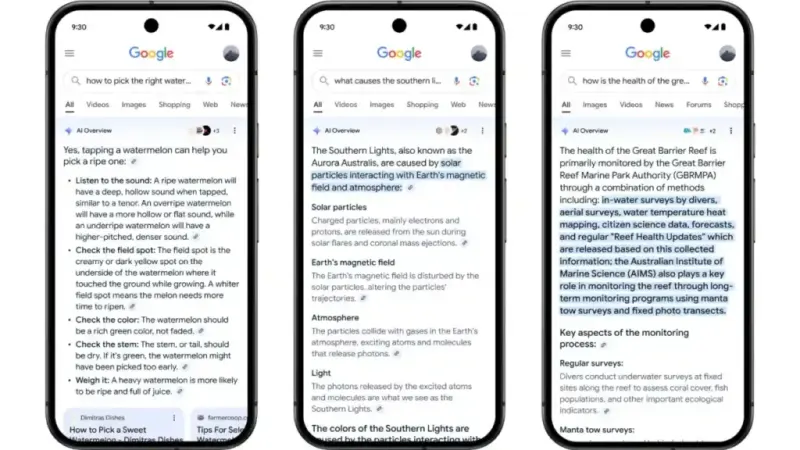
The picture isn’t that bleak. NewzDash CEO John Shehata’s tracking found Google now folds entire Top Stories carousels directly inside AI Overviews on 15.5% of U.S. trending news queries and 17.46% in the UK, with entertainment and world news queries leading both markets. So now, Top Stories doesn’t appear as a separate module further down the page, which means the AI Overview itself becomes a direct pathway to publisher links rather than only a replacement for them.
Here are two common misconceptions:
- Blocking Google-Extended in robots.txt doesn’t remove a site from AI Overviews or embedded Top Stories. Google’s own documentation says Google-Extended only governs AI training and grounding uses, not inclusion in Search.
- A new generative AI exclusion setting inside Search Console, currently in beta for a subset of UK site owners, does let publishers opt content out of AI Overviews and AI Mode specifically. Choosing it also appears to forfeit the embedded Top Stories slot, since that slot is built from opted-in publisher links.
Eligibility for Top Stories follows the same fundamentals it always has; a structured data, fast-breaking original coverage, clear bylines, and technical health. Publishers chasing that carousel spot aren’t doing anything exotic; they are just doing conventional news, but with spot-on SEO well and consistently.
How News Publishers Are Adapting Their SEO Strategy for AI Overviews
The publishers holding traffic steady have made one change ahead of everything else. They optimize articles to be the cited, linked source inside an AI answer, and not just optimizing to rank first on a page nobody scrolls past anymore.
Optimizing AI content and on-page structure for AI overviews
AI content in this context means content structured so AI systems can extract and cite it accurately. It isn’t about AI-written content. Confusing the two leads to bad decisions. The tactics that actually help:
- Write a direct, extractable answer in the first two sentences after every heading, with no preamble. This process is also known as AEO.
- Use question-based subheadings that match how people actually search, rather than repeating the exact target keyword.
- Add Article, NewsArticle, and FAQ schema markup so Google’s systems can parse the page’s structure with confidence.
- Keep data, pricing, or statistics in real HTML tables, not bullet lists pretending to be one.
- Publish a byline with a named author and their credentials on every piece, not just a masthead credit.
Building E-E-A-T signals that get you cited in AI search results
When a machine decides which sources to quote instead of a reader browsing links, authority signals start getting important. Google’s model is choosing on the reader’s behalf, and it’s choosing based on trust markers it can verify programmatically.
- Cite primary sources directly (court filings, official statistics, on-the-record interviews) rather than paraphrasing another outlet’s coverage.
- Keep author bio pages current with credentials, past reporting, and a real photo.
- Publish original data or first-hand reporting that can’t be found by reading the rest of page one.
- Maintain a visible corrections policy and editorial standards page, both of which are consistent E-E-A-T signals Google has confirmed it looks for.
AEO and GEO: Preparing Your Organic Traffic Strategy for the Next Shift
Two acronyms are worth knowing if you’ve not already run into them. Answer Engine Optimization (AEO) is the practice of structuring content so it gets selected as the direct answer inside AI Overviews, voice assistants, and featured snippets. Generative Engine Optimization (GEO) is the broader discipline of getting cited by generative AI tools like ChatGPT, Perplexity, and Gemini, which pull from a different (and often overlapping) set of ranking signals than classic Google Search.
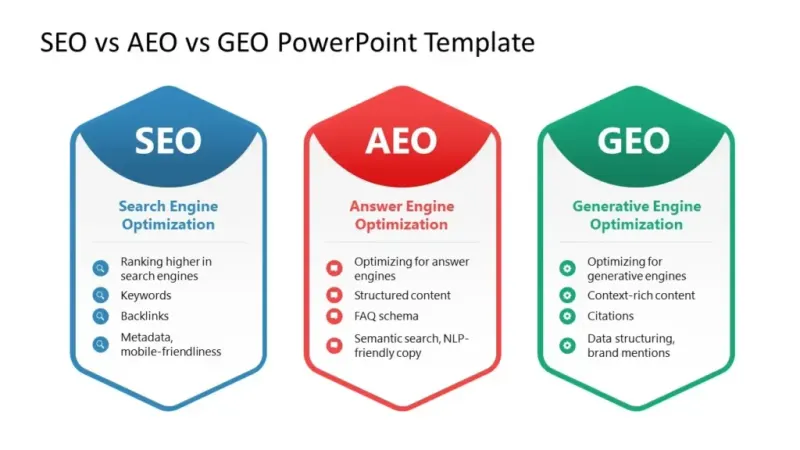
The shift’s in measurement. Classic SEO strategy tracked rankings and clicks. AEO and GEO require tracking citations, brand mentions inside AI answers, and referral traffic from AI platforms as their own channel. And since a page can be doing very well by AI visibility standards while its Google Search Console click numbers look flat or falling.
Actionable Steps to Protect Your Organic Traffic From AI Overviews
Start with the items that protect existing traffic, then move to the ones that build new channels.
| Action | Expected outcome |
| Add Article and FAQ schema to every news and evergreen page | Better AI Overview and rich-result eligibility |
| Rewrite top 20 traffic-losing pages with answer-first openings | Higher extraction and citation rate |
| Build or expand an email newsletter | Traffic channel AI Overviews cannot intercept |
| Shift evergreen budget toward original reporting and data | Content less summarizable by a generative model |
| Audit Google-Extended vs. Search Console AI exclusion settings | Accurate opt-out decisions instead of false confidence |
| Track AI referral traffic and citations separately in analytics | Visibility into GEO performance, not just Search clicks |
None of this reverses the underlying trend. It narrows how much of it lands on any one publisher.
Final Thought
AI Overviews haven’t made good journalism obsolete; they’ve just made mediocre, easily-summarized content much easier to skip. The publishers losing the most traffic are the ones whose value proposition was answering a simple question faster than their competitors, but that’s precisely the job Google’s model was built to do.
The ones holding steady are leaning into what a generative summary still can’t replace. Like original reporting, named expertise, and a direct relationship with readers that doesn’t run through a search results page at all. Adaptation is the only strategy with a track record so far.
FAQs
Yes. In addition to the increase in AI Overviews, there was a 42% decrease in organic clicks for a sample of 64 sites, though the reduction was much smaller for breaking news versus evergreen explainer content.
Partially. The new Search Console setting is currently in Beta (mid-2026) and applies to AI Overviews and AI Mode. Blocking Google-Extended does not do this; it only applies to AI training and grounding uses.
Start each section with a straight two-sentence answer; include Article and FAQ schema markup; use real HTML tables, as opposed to the tables in the HTML source generated by WordPress; and use named bylines with visible credentials for Google’s systems to check.
SEO is focused on ranking and clicks on Google Search. AI Overviews are summaries of AI-generated overviews and snippets made of the direct answer. GEO is geared toward citations within generative tools such as ChatGPT and Perplexity, which are not tracked through Search Console.
Not entirely. They sit on top of the normal results, and they will push the first organic link down the page a lot, but Google will still send most news queries to a carousel for the Top Stories, instead of a generated summary.
Move away from evergreen website content to diversifying into original reporting, email newsletters, and subscriptions. For the same publishers, subscription revenue rose by 14.4% across the board in early 2025, even though they were seeing a drop in traffic from search.