


For years, winning at marketing meant mastering SEO to climb Google’s search rankings. But AI has changed the rules. It’s no longer enough to be the best link; you have to be in the AI-generated answer. This requires a new marketing strategy: Generative Engine Optimization (GEO). In this post, I’ll talk about SEO and GEO, what you need to know to balance both and succeed in this new era of search.
Key Takeaways
- SEO Ranks, GEO Informs: SEO’s job is to get your website ranked on a list. GEO’s job is to influence the AI so your brand, data, and content are featured inside the generated answer.
- Structured Data is the Key: The most effective GEO strategy is using structured data (Schema markup). It’s how you translate your content into a clear, factual language that AI models can easily understand and trust.
- It’s Not a Replacement, It’s an Evolution: You don’t abandon SEO for GEO. A strong SEO foundation – built on quality content and authority – is the price of entry. GEO is the next layer you add to win in the age of AI. SEO and GEO go hand-in-hand.
What is SEO and GEO?
Let’s break down these two concepts simply.
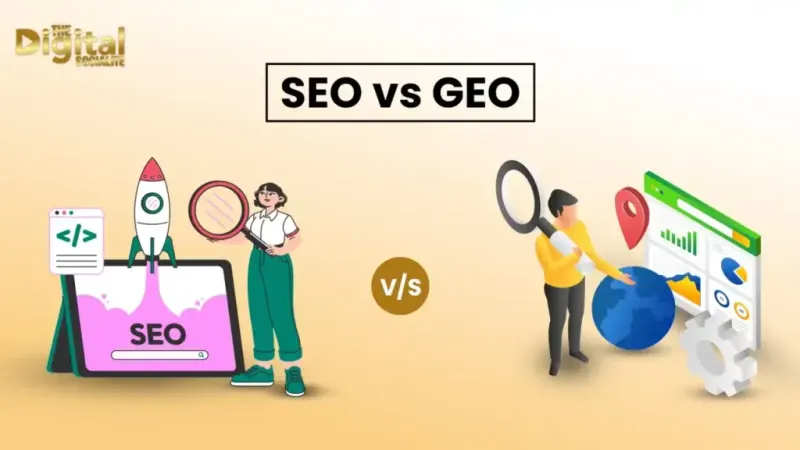
- SEO (Search Engine Optimization) is that traditional practice we all know. It is the process of optimizing your website search ranking to go higher in the organic results (the blue links). Its main goal is to improve visibility and attract clicks to your website by signaling to Google that you are a relevant and authoritative source for a given keyword.
Take a look at this post on SEO tips for beginners.
- GEO (Generative Engine Optimization) is the new frontier. It is the practice of influencing generative AI models (like Google’s AI Overviews or Perplexity) so they use your information when creating an answer. The goal isn’t just to be a link below the answer; it’s to be cited as a source within the AI-generated summary itself.
The Shift from SEO to GEO
The shift is driven by a fundamental change in user behavior and technology. For years, Google’s job was to be a directory – to point you to the best possible websites where you could find your answer.
Now, with powerful AI, Google’s job is to be the answer engine.
When a user gets a comprehensive, AI-generated summary at the very top of the page, their journey often ends right there. They may never scroll down to the traditional blue links. I’ve seen this firsthand: if you’re not part of that AI-generated answer, you are effectively invisible to a growing number of users. This is why we have to shift our focus from just search ranking (SEO) to also influencing (GEO).
Key Differences between SEO and GEO
While they are related, it’s helpful to look at their distinct goals and methods.
| Aspect | SEO | GEO |
| Primary Goal | To get a webpage’s search ranking as high as possible in the list of organic results. | To have your brand, data, or content featured and cited within an AI-generated answer. |
| Core Focus | Keywords, backlinks, and on-page technical optimization. | Structured data, factual accuracy, entities, and brand authority. |
| Success Metric | High organic ranking (e.g., Position 1-3) and click-through rate (CTR). | Citations, brand mentions, and inclusion in AI-generated summaries. |
| The Output | Your website appears as a blue link on the Search Engine Results Page (SERP). | Your content or data is woven directly into the AI’s narrative response. |
Similarities Between SEO and GEO
It is important to note that GEO isn’t exactly starting from scratch. It is built on the same core principles that have always defined good marketing.
- Both Require High-Quality Content: Neither marketing strategy works without valuable, well-researched, and user-focused content.
- Both Rely on Authority (E-E-A-T): Both search engines and generative engines want to pull from sources that demonstrate Experience, Expertise, Authoritativeness, and Trustworthiness.
- Both Aim to Satisfy User Intent: At the end of the day, both are about giving the user the best possible answer to their query, whether in the form of a link or a generated summary.
What are the Key Features of SEO and GEO?
Here’s a look at the specific tactics that define each practice.
| SEO Features (The Foundation) | GEO Features (The AI-Layer) |
| Keyword research and targeting | Structured data (Schema Markup) |
| On-page optimization (titles, metas) | Entity optimization (knowledge graph) |
| Link building and domain authority | Factual accuracy and clarity |
| Technical SEO (site speed, mobile-friendliness) | Content freshness and regular updates |
| User experience (UX) signals | Sourcing and citing reputable data |
Why is GEO Important in AI Search?
GEO is important for one simple reason: survival.
As AI-generated answers take over the most valuable real estate at the top of the search results, traditional blue links get pushed further down the page, becoming less visible. If your marketing strategy only focuses on SEO, you are competing for a shrinking piece of the pie.
I believe that brands that master GEO will be the ones that AI models learn to trust and cite as authoritative sources. This doesn’t just put you in the answer box; it builds immense brand credibility and positions you as a leader in your field for the next era of digital discovery.
What are the GEO strategies?
Here are the actionable strategies aimed to optimize for generative engines:
- Embrace Structured Data (Schema): This is the single most important GEO tactic. Use Schema markup to label your content clearly. Tell the AI, “This is a product,” “This is a review,” etc. It removes all guesswork.
- Optimize for Entities, Not Just Keywords: Ensure your brand, products, and key people are clearly defined “entities” in Google’s Knowledge Graph. This means having a complete Google Business Profile, a Wikipedia page (if applicable), and consistent information across the web.
- Prioritize Factual, Unambiguous Content: AI models thrive on clear facts. Write in simple, direct language. Present data in tables. Answer questions clearly and concisely. Avoid vague marketing fluff.
- Publish Original Research and Data: One of the best ways to get cited is to be the primary source of a statistic or study. Publishing original data makes you an essential source for AI to reference.
What are the Benefits of Incorporating GEO?
When you successfully add GEO to your marketing strategy, the benefits are significant.
- Prime Visibility in AI Overviews: You appear in the most prominent position on the search page – the answer itself.
- Enhanced Brand Authority and Trust: Being cited by Google’s AI is a powerful endorsement that positions you as a definitive expert.
- Future-Proofs Your Marketing: You are preparing your brand for a future where search is increasingly conversational and answer-driven (e.g., voice assistants, AI chatbots).
- Captures “Zero-Click” Attention: Even if a user doesn’t click, they see your brand’s name and information, increasing brand recall and trust.
How to Balance SEO and GEO for Best Results
This is the key question every marketer should be asking. The answer is not to abandon one for the other. Here’s my recommended approach:
- Start with a Strong SEO Foundation: You cannot have good GEO without good SEO. Ensure your site is technically sound, fast, secure, and has high-quality content that targets relevant keywords. This builds the initial authority AI needs to see.
- Layer GEO on Top of Your Best Content: Identify your most authoritative pages – the ones that already rank well. Go back and enrich these pages with structured data and clearer, factual language. This is your low-hanging fruit.
- Integrate GEO into Your Content Creation Process: When creating new content, think about both SEO and GEO from the start. Ask yourself: “What keywords am I targeting?” (SEO) and “What direct questions can I answer and label with structured data?” (GEO).
Final Thoughts
The shift from a list of links to a direct answer is arguably the biggest change in search since Google was founded. It can feel daunting, but I see it as an incredible opportunity.
The core principles haven’t changed. We still need to create the best, most helpful, and most trustworthy content for our audience. GEO is simply the new technical framework for communicating that value to AI.
Frequently Asked Questions (FAQs)
Should I stop doing SEO and focus only on GEO?
Absolutely not. The way I see it, that would be a critical mistake. SEO builds the foundational authority and trust that generative engines use to decide which sources to feature. You need SEO to even be considered for GEO. Thus, both SEO and GEO are crucial.
What is the single most important first step I can take for GEO?
Start with structured data. Conduct an audit of your website to find opportunities to add Schema markup to your key pages (e.g., product pages, articles with FAQs, contact pages). This is the most direct way to start “speaking the language” of AI.
Is GEO only important for large brands?
Not at all. I’ve found that local and niche businesses can benefit immensely. Optimizing a local business’s address, hours, and services with structured data can make it the definitive answer for local AI-powered queries, driving real-world traffic.